Where shall I start? Well, I suppose I must accredit working at a Swedish shop for four years as the reason why I wanted to explore Northern Europe. The numerous rainy, boring days spent flipping through books describing the people, the traditions, and the beautiful land might have to do with why I chose to fly there for Spring Break. Or, and more likely the reason, I needed to visit my long lost Swedish friends from this same shop. Four friends who made my summers fly by with fun times, whether we were working or partying. So I flew to Malmö in southern Sweden to spend a week catching up with Per, P2, Nicholas, and John.
 |
| Welcome to Malmö |
When I first heard Per speak Swedish back in the USA I could not stop laughing. Back then, it sounded like the gargling of a baby. Lots of goos and gahs and skas and skoos. Amazingly enough, after a week I could begin to differentiate emotions and a few vegetables on menus. Swedish started to sound like a language I had heard all my life. As a result of my time in Malmö, I have recently added another language to my "To Know" list.
After a day of layovers and trains, I walked straight past Per in the train station; I was so out of it. I got a brief tour of the city and we were off to eat pizza and meet up with the other guys. Where's the meatballs and Swedish fish you ask? Well I've learned that Malmö is actually a very international city and thus there's more ethnic restaurants than strictly Swedish. Plus, who can give up pizza (especially when France has no idea what it's doing with the crust)?
The next morning I woke up and was off to explore Malmö (since all the guys had school). First stop, the churches. Unfortunately they were all closed for repairs but I was able to at least appreciate the different architecture style from the outside.
 |
| St. Petri (Peter in English) |
 |
| Awesome door |
Next, the squares...stortoget (the big "meeting place" square) and lilla torg (little square, full of restaurants and bars). I met up with the boys for lunch (again international...Thai!) and then was off to the local castle, Slottet Malmöhus.
 |
| |
| City Hall |
|
|
|
|
|
|
From the outside, it was not all that impressive but once I went inside and began to learn about the history my opinion changed instantly. This castle is the oldest surviving Renaissance castle (built in 1434.) The location was perfect because the west side of Malmö could be protected from intruders and shipping on the from the southern side of the city could be monitored. More interesting facts:
- Denmark's coins were minted here in the Middle ages.
- Crown Prince Frederick held wild parties in the 16th century.
- King Eric of Pomerania was only 15 when he was crowned king of Scandinavia (now modern day Denmark, Norway, and Sweden) in 1397.
- Eric was actually the adopted son of Queen Margaret I, but he was recognized as the official heir nonetheless (amazing if you compare it to England's lineage problems).
- After almost two centuries of war between Denmark and Sweden (for Malmö and the general area of southern Sweden (Skåne)), the castle was turned into a prison for war captives and criminals. In 1828 it was one of Sweden's largest and most modern jails. It held at most 1,000 criminals including women. In 1909 the jail was emptied.
 |
| Dining Hall |
 |
| The outside |
 |
| Photos of past prisoners |
 |
| The windmill in the King's gardens |
Next, off to the museums (which were included in the price of the castle; how I love Sweden and their efficiency). First I went to Konstmuseum, their art museum. This included an exhibition on the dress and music of the 1920s, traditional Swedish artwork and furniture, as well as modern art. Then, I briefly walked around the Malmo Museer. This was a bit more odd, featuring submarines, parts of planes and cars, as well as steam engines. More of a mini Ben Franklin Museum if you will. I then walked through the Kungsparken (King's gardens) back to Per's apartment to barbecue and watch the Madrid-Barcelona game.
 |
| Old traditional Swedish furtniture |
 |
| An awesome chest of drawers I'd love to recreate for my future house |
 |
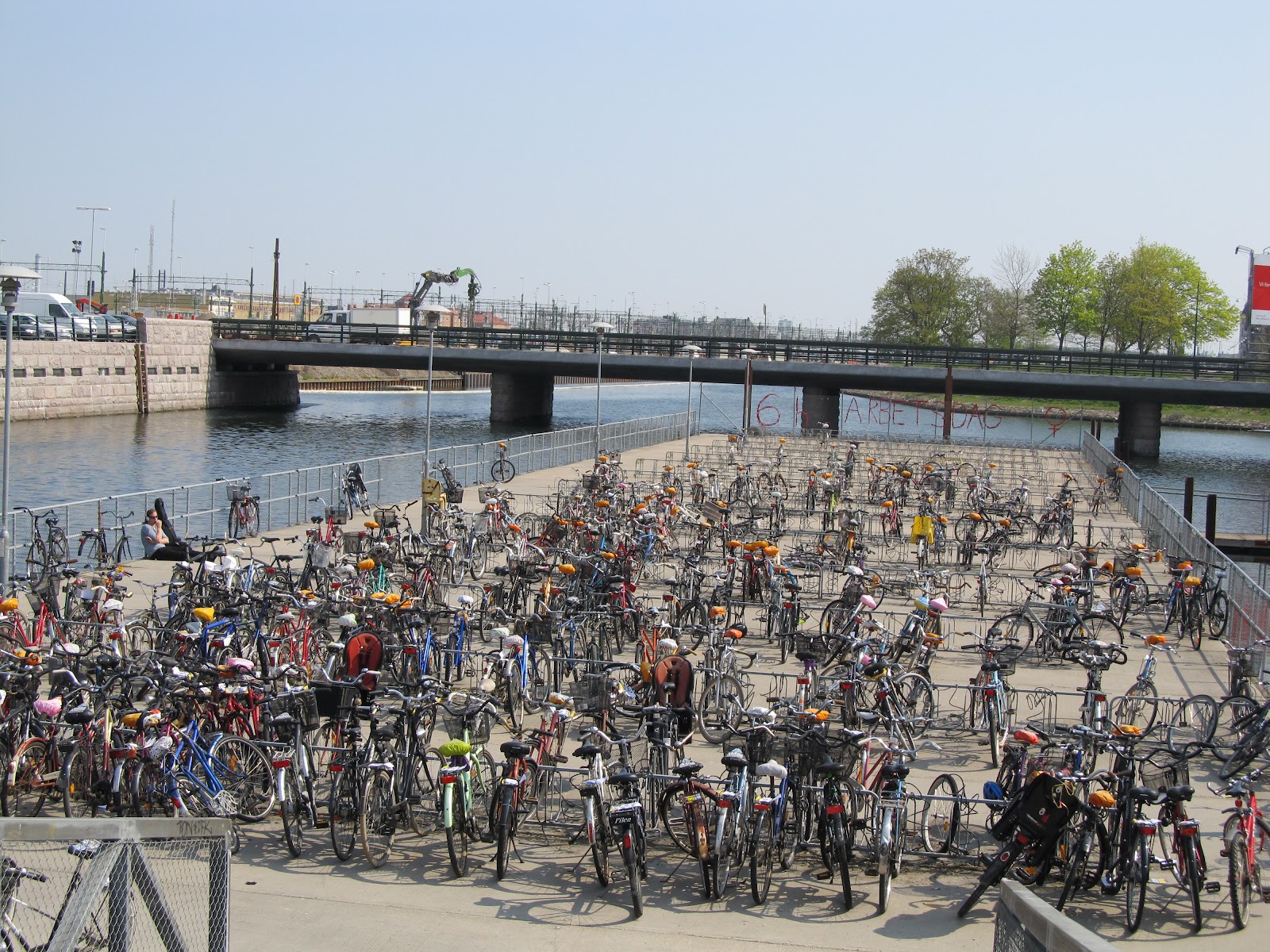
| Bike parking lot across from the train station |
 |
| Traditional houses |
The next day I decided to cross the bridge back over to Denmark and check out Copenhagen (actually spelled Køpenhavn in Dannish). Of course I got lost, getting off at the wrong stop on the train and then taking the metro in the wrong direction. I proceeded to give up any pride in my navigation skills and ask the way to Tivoli, the city's famous amusement park. Tivoli is the world's 2nd oldest amusement park; it opened its gates in 1843.
 |
| The theater |
 |
| Boat rides |
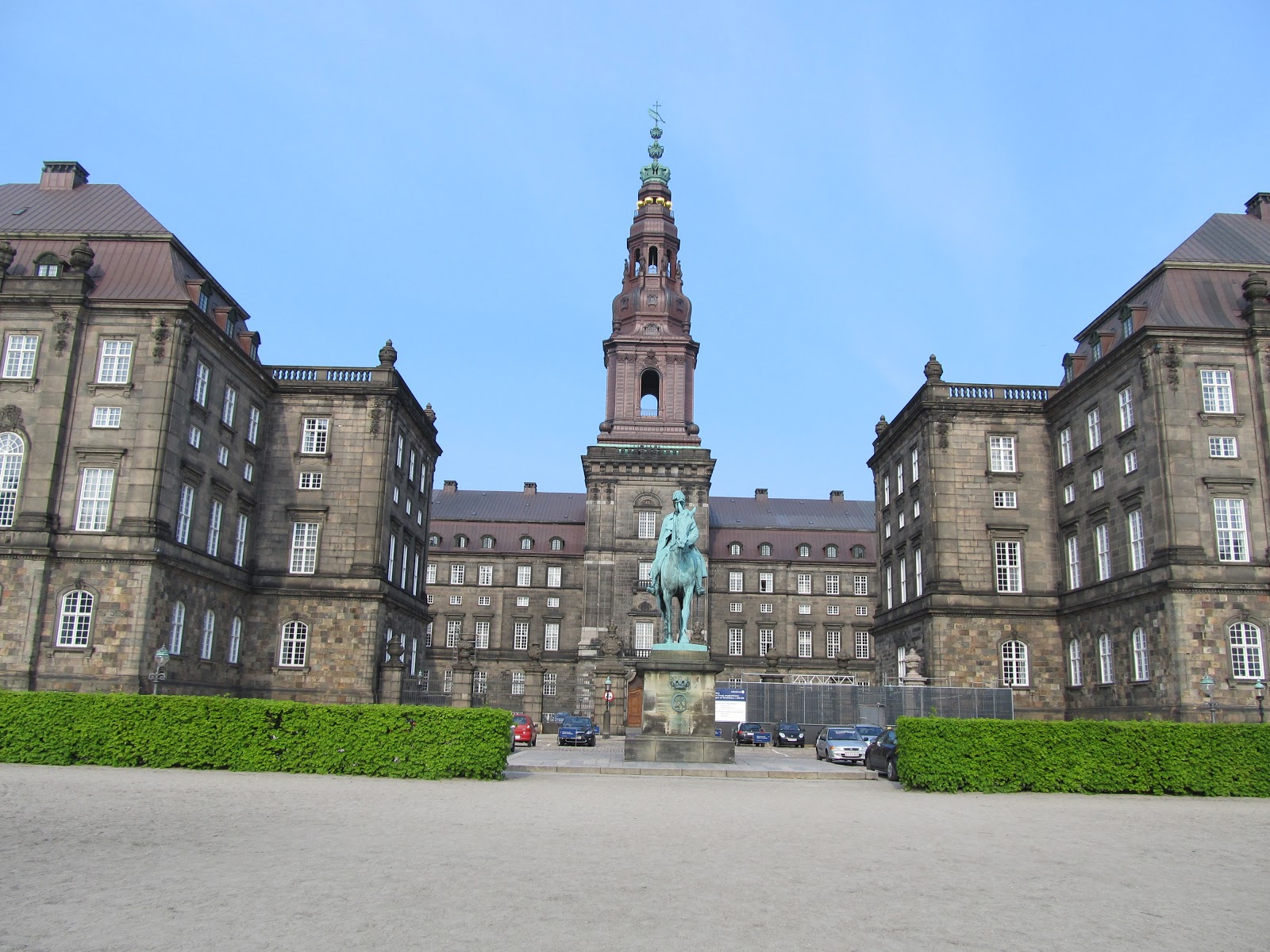
Next I headed to the Christiansborg Palace. I made it just in time for an English tour. We had to cover our shoes with blue booties despite the fact that the Queen actually lives in one of the other palaces. More interesting history for you all that I discovered on my tour:
- The present palace is the third to be built on the site. It was finished in 1928 after much debate over finances for its construction/usage. The previous two burnt down in 1794 and 1884 respectively.
- The Parliament, Royal Reception Rooms, the Prime Minister's Office, and the Supreme Court are housed in the present building. The Prime Minister's office was literally roped off; no security guards, no glass doors seperating the public, nothing. Our tour guide's joke: "We're not as obsessed with security as America. We all feel safe in our country." I'm definitely not looking forward to going back to the fear that's for sure.
- The Throne Room is used for New Years and the Queen's reception of foreign ambassadors. The walls are covered in silk (from none other than Lyon!).
- The Great Hall seats 400 guests and is the largest room in the palace. The walls are decorated with a set of woven tapestries by Bjørn Norgaard, a Danish artist. The tapestries were the Queen's 50th birthday present but they weren't finished until her 60th birthday. The tapestries depict the history of Denmark, from the vikings to the current Queen. Each tapestry was so ornately designed that we took almost a half hour to learn about the symbolism of one tapestry. I went back into the room later to learn about the others. It's this sort of thing that makes you really appreciate your liberal arts education. The tour guide also showed us how the staff would be able to take down the tapestries in case of a future fire.
- After the tour, I went underneath the palace to discover the ruins of the other two palaces. The most interesting ruin was that of the Blue Tower. It was here that prisoners were held. The most famous one was Leonora Christina, the daughter of King Christian IV. Her husband was branded a traitor and thus as a result, she too was kept in the tower for 22 years.
 |
| Christiansborg Palace from the carriage entrance |
 |
| The old Stock Exchange building in Copenhagen |
 |
| Denmark! |
 |
| Crazy towers |
 |
| And another! |
 |
| They put me to shame, biking everywhere! |
 |
| The harbor |
 |
| Amalienborg Palace-where the Queen actually lives! |
 |
| Hey there Dannish boys! |
 |
| Rosenborg Castle |
The next day, I decided to head to the beach. It was unbelievably windy but no one was to be seen. I felt like I was back in Rehoboth when everyone leaves for dinner and you have the sand, sun, and water to yourself. I then headed to check out the Turning Torso. A random, lonely skyscraper in Malmö full of what I can only assume to be amazing apartments. I stopped for a coffee by the beach before walking back across the city. I had forgotten how much the Swedes loved their coffee until A) this man seemed insulted I only took two cups when he offered an endless amount B) Per made coffee for everyone at 11 pm.
In the afternoon P2 took me to Lund, the university town a little over a half an hour away. We checked out the famous cathedral, walked around the grounds, and then drove through the residential area to see the traditional houses. From there, we took off to Lilla Torg for beer night. Apparently you have to get there super early in the afternoon to get the best people watching tables, but we still made do :)
 |
| From the beach, the infamous Turning Torso |
 |
| Malmö's beach with the Øresund bridge to Denmark in the background. |
 |
| The Lund Cathedral |
 |
| Dorms at Lund University |
 |
| I would never get any studying done if I went here. |
 |
| Baby houses in Lund |
 |
| The fake castle P2 tried to play off as real. |
Finally, on Saturday was the much awaited, Valborgsmässoafton. A day celebrating Spring, it is known for the massive bonfires used to shoo away witches (which, translated from Swedish, means a day long drinking event.) After checking out the local harbors in P2's hometown in the morning, we headed to Pildammsparken (the other massive park in Malmö). I met the other infamous Swedes who worked at the Swedish shop before me as well as other close friends of the guys. I can definitely say that Swedish people are extremely welcoming, friendly, and interested in what you have to say. You don't feel a sense of judgement as you do with other people. Plus they sure do know how to party; their king must have passed down some sort of secret gene. My skills were not even close to comparable and their sweet, delicious ciders got the best of me.
Overall, a week well spent with awesome people. I cannot wait to go back and explore more! Moreover, I cannot wait to know how to prononce words like this: